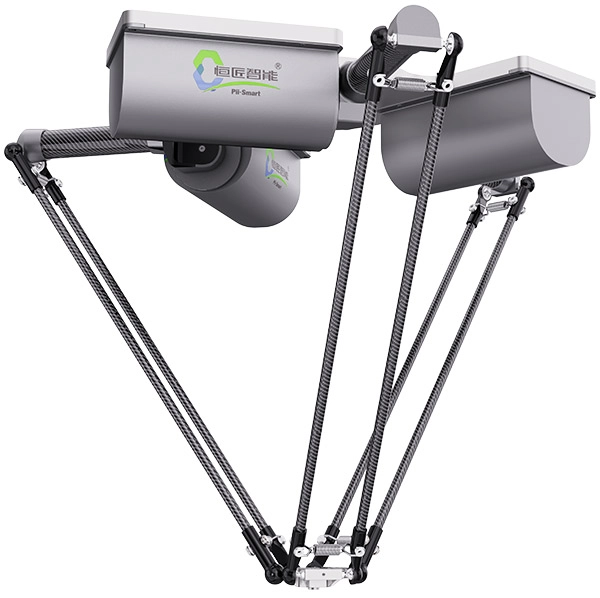
As one of the leading delta robot manufacturers serving the global food, pharmaceutical, and electronics industries, Hengjiang Intelligent Technology Co., Ltd. (brand: Hexeon) designs and supplies high-speed, high-precision delta robots and fully integrated automation workstations. Every unit is engineered for demanding production environments where accuracy, throughput, and hygiene compliance are non-negotiable.
Our complete industrial robot lineup — including standalone delta robots, flexible robot-based sorting and handling workstations, full-line robot sorting and packaging systems, and robotic flexible integrated production lines — is built to reduce labor dependency, raise output consistency, and deliver measurable ROI from day one.
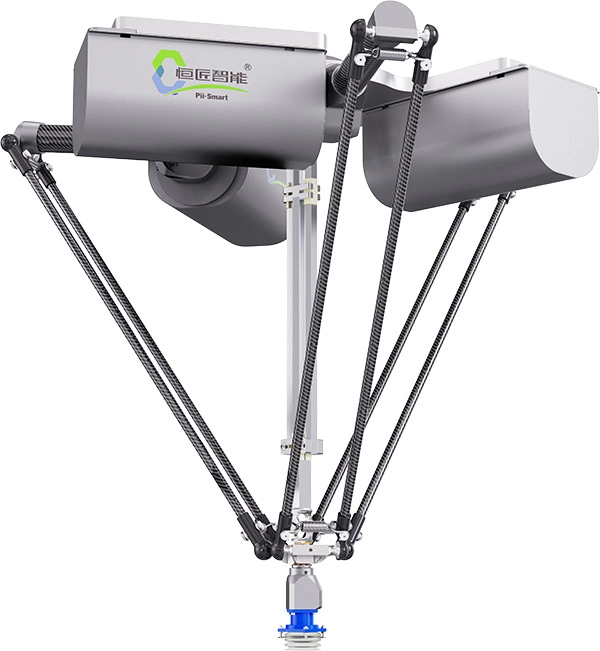
A delta robot is a parallel-linkage manipulator in which three independently driven arms connect a fixed upper base to a mobile lower platform (end-effector). Because all actuators are mounted on the fixed base, the moving mass is extremely low. This structural principle — first formalized by Reymond Clavel at EPFL in the 1980s (source: Clavel, R., "Device for the movement and positioning of an element in space," US Patent 4,976,582, 1990) — allows delta robots to achieve accelerations of up to 10 G and cycle rates well beyond what serial-arm or SCARA architectures can sustain for lightweight payloads.
In Hexeon's HJ-D11003-1 series, carbon fiber rods replace conventional steel linkages, further reducing inertia while preserving rigidity. The result is a robot capable of 40–100 picks per minute with a repetition positioning accuracy of ±0.2 mm — performance figures validated across food, pharmaceutical, and electronics production lines.
The kinematics of a delta robot are solved through inverse kinematics: given a target Cartesian coordinate (X, Y, Z) for the end-effector, the controller back-calculates the required joint angles for each of the three arms simultaneously. Hexeon's proprietary control software performs these calculations in real time, synchronizing robot motion with upstream conveyor speed and downstream packaging triggers.
Product Range: Delta Robots and Integrated Systems
The HJ-D11003-1 delta robot platform is available in two configurations to match different application requirements.
The HJ-D11003-1 Delta Robot with Rotary Axis adds a fourth servo-driven rotation axis to the end-effector, enabling the robot to reorient products during transfer. This is critical when incoming items arrive in random angular positions — for example, bar-shaped or square frozen pastries that must be placed in a consistent orientation before packaging. The rotary axis handles products including round, bar, and square cross-sections, sorting them neatly from disordered upstream flow onto a separate conveyor belt for orderly discharge into the packaging zone.
The HJ-D11003-1 Delta Robot non-rotary variant is configured for applications where product orientation is already controlled by the upstream line or where the gripping geometry makes rotation unnecessary. Both variants share the same base platform, control architecture, and IP65 protection rating, making them interchangeable at the installation level.
Key technical specifications for the HJ-D11003-1 series:
Rated working envelope: H 250–400 mm, diameter 580–1,100 mm
Effective load: 6–20 kg
Pick-up speed: 40–100 picks per minute
Repetition positioning accuracy: ±0.2 mm
Protection level: IP65
Noise level: less than 68 dB(A)
Robot body weight: 92 kg
Mounting method: overhead ceiling-mount
Operating floor load requirement: average ≥ 500 kg/m²
Vibration tolerance: ≤ 0.5 G
Electromagnetic environment: free from strong radio or electromagnetic interference
For manufacturers that need a production-ready cell rather than a bare robot, the Delta Robot Workstation integrates the HJ-D11003-1 robot with a conveyor system, machine vision, gripper tooling, and Hexeon's digital operating system into a single deployable unit.
The workstation is offered in two standard formats. The Single-Unit Delta Robot Workstation is suited for lines with moderate throughput where one robot handles the full picking and sorting cycle. The Donut Robot Sorting Workstation is configured for high-volume frozen snack lines, where the robot must sort, orient, and stack products such as donuts, dumplings, or steamed buns into trays or cartons at high cadence.
Vision-guided operation: Integrated cameras capture each incoming product's position, shape, and — where color sorting is required — chromatic properties. The control system maps every detected item to a pick coordinate and queues actions to eliminate missed picks even when the upstream belt is loaded irregularly.
Temperature-tolerant design: The workstation maintains full performance in sub-zero freezing environments, making it the preferred choice for frozen food processors where conventional automation routinely fails due to condensation and material contraction.
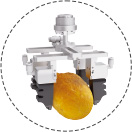
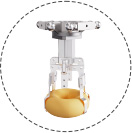
Gripper modularity: Grippers can be configured in two-finger, four-finger, or six-finger layouts. Contact surfaces use soft, food-grade materials to protect delicate items — layered pastries, cream-topped products, items with toppings or sprinkles — without surface damage. Adjusting the gripper to a new product family requires no major mechanical rework, supporting fast SKU changeovers.
For manufacturers requiring coordinated multi-robot automation across an entire line, Hexeon offers two integrated system architectures.
The Combined Use of SCARA and Delta Robots integrated workstation pairs the delta robot's high-speed pick-and-place capability with the SCARA robot's longer reach and heavier payload capacity. Delta units handle rapid upstream sorting; SCARA units manage downstream assembly, labeling, or carton loading. The result is a seamless hand-off architecture that eliminates the bottlenecks typically created when a single robot type is asked to cover the full line.
The Dual-Unit and Multi-Unit Delta Robot Applications deploy two or more delta robots in a parallel cluster over the same conveyor. Each robot operates an independent pick zone and communicates with adjacent units to avoid collision while collectively sustaining line throughput that no single robot could achieve alone. This architecture is particularly effective on wide conveyor lines and for products that vary significantly in size or weight within the same batch.
Both integrated systems connect to Hexeon's self-developed digital operating system, which provides a unified interface for monitoring, parameter adjustment, and predictive maintenance across every robot on the line.
For SCARA-based automation needs, the SCARA Robot Workstation and the SCARA Robot Sorting and Packaging Line offer complementary solutions within the same control ecosystem.
Low Dynamic Inertia: The parallel-linkage structure keeps all drive motors stationary at the base. Only the lightweight carbon fiber rods and end-effector travel with each pick cycle. This design reduces dynamic inertia to a minimum, enabling extremely fast directional changes without the resonance or vibration that limits serial-arm robots at high speeds.
High-Precision Control with Low Cumulative Error: The control algorithms combine feedforward motion planning with closed-loop servo feedback. Over extended production runs, cumulative positioning error remains within ±0.2 mm, which is essential for consistent placement into fixed-dimension packaging inserts or pharmaceutical blister cavities.
Food-Grade 304 Stainless Steel Construction: The majority of components that could contact food product — structural brackets, mounting plates, and end-effector bodies — are manufactured from 304-grade stainless steel. This ensures compliance with food safety regulations across major markets without requiring additional field modification.
Patented Operating System with Multi-Device Access: Hexeon's control platform is operated via smartphone, tablet, computer, or integrated touchscreen. Line operators can adjust motion parameters, switch between product recipes, and monitor robot status without specialized PLC programming knowledge, reducing commissioning time and ongoing maintenance overhead.
IP65 Environmental Sealing: The robot body is sealed to IP65, protecting all internal electronics and drive components from water jets and particulate ingress. This is the minimum acceptable standard for wash-down zones in food manufacturing and is equally important in pharmaceutical cleanrooms where humidity control is strict.
Collaborative Multi-Robot Operation: When multiple delta robots are deployed in a cluster, each unit operates its own pick schedule while sharing upstream conveyor data through the common control network. The system automatically balances the pick load across units, compensates when one robot is performing a maintenance pause, and adjusts individual cycle timing to maintain overall line cadence.
Food and Bakery Production: Hexeon's delta robots are deployed across pastry production lines, croissant lines, laminated dough sheeting lines, sausage roll bread shaping lines, egg tart molding lines, donut forming lines, pizza forming lines, and pie and soufflé production lines. The robot handles the post-forming, sorting, and tray-loading stages where manual labor is typically the throughput bottleneck and hygiene risk is highest.
Frozen Food Processing: In sub-zero environments, the delta workstation sorts and stacks frozen donuts, dumplings, steamed buns, and similar products without product damage or placement errors, even when surface condensation alters product grip characteristics.
Pharmaceuticals and Medical Devices: Precise positioning at ±0.2 mm enables reliable loading of capsules, tablets, or small medical components into blister packs, vials, or inspection trays at high cycle rates.
Electronics Manufacturing: Component pick-and-place for PCB assembly, optical component handling, and small-part sorting benefit from the low inertia and high repeatability of the delta architecture.
Logistics and E-Commerce Fulfillment: Sorting lightweight parcels, pouches, and envelopes onto diverging conveyor lanes at throughput rates that manual sorting cannot match.
Daily Chemical and Consumer Goods: Soaps, cosmetic units, and packaged powders with consistent form factors are efficiently handled by configuring the gripper geometry to the product envelope.
The end-effector is the critical interface between the robot and the product. A poorly designed gripper negates the speed and precision advantages of the robot body. Hexeon engineers gripper assemblies matched to each product family:
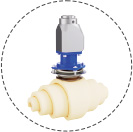
Two-finger grippers are used for elongated products like sausage rolls or individually wrapped bars where pinch contact on two opposing faces is sufficient for secure transfer.
Four-finger grippers distribute contact force across four points, reducing peak surface stress on fragile products like layered pastries or tart shells.
Six-finger grippers extend capacity for larger or heavier products, increasing the contact area to prevent deformation during rapid acceleration and deceleration.
All food-contact gripper surfaces use soft, compliant, food-safe materials that conform slightly to product surface irregularities, preventing cracking or surface damage to glazed, toppings-covered, or cream-filled items. Non-food applications use harder gripper materials optimized for positional rigidity.
Gripper tooling is designed for tool-free swap, meaning a changeover from one product configuration to another can be completed by a single operator in minutes — an important advantage on lines running multiple SKUs across a shift.
Hexeon's delta robots and workstations are designed for integration with standard industrial ecosystems. The control system communicates via common industrial protocols, making connection to upstream forming or baking equipment and downstream packaging machinery straightforward.
Installation follows a structured commissioning process detailed in Hexeon's service and support program. The robot is mounted to an overhead frame — supplied as part of the workstation — above the conveyor. Power and data connections are routed through cable management channels integrated into the frame. The vision system cameras are fixed at a defined height above the conveyor and calibrated to the working envelope during commissioning. Motion parameters — pick speed, acceleration profile, placement coordinates, and upstream belt synchronization — are configured in the control interface and saved as named product recipes.
After commissioning, Hexeon's service team conducts equipment acceptance inspection, verifying that all specified performance parameters are met under production conditions. Ongoing support includes remote monitoring capability, which allows Hexeon's engineers to diagnose issues and push software updates without requiring an on-site visit. For detailed maintenance schedules and post-sale support procedures, visit the equipment inspection and service advantages section.
Hexeon — the commercial brand of Hengjiang Intelligent Technology Co., Ltd. — combines deep domain expertise in baking and food processing automation with the mechanical and control engineering capabilities of an industrial robot manufacturer. This combination is uncommon: most industrial robot suppliers have no food-industry specialization, and most food machinery companies lack in-house robot development capability.
The result is a high-speed delta robot system designed from the ground up for the conditions that food manufacturers actually face: wet and humid environments, frequent product changeovers, mixed-SKU production batches, wash-down cleaning cycles, and food safety certification requirements. Every design decision — from the choice of 304 stainless steel for structural components to the soft food-grade gripper surfaces to the IP65 sealing — reflects the operational realities of food production rather than a generic industrial specification.
Hexeon's proprietary digital operating system is another differentiator. Unlike third-party robot controllers that require specialized PLC programming to integrate with production equipment, Hexeon's platform is purpose-built to interface with the company's own baking production lines, covering every forming and shaping line in the portfolio. This means faster commissioning, simpler operation, and a single point of contact for the entire automated system.
To learn more about the company's background, engineering culture, and global service network, visit the Hexeon Group company page. To request product specifications, pricing, or a project consultation, use the online inquiry form on the contact page.
To view working demonstrations of delta robots in food production environments, visit the baking robot video gallery.